
Good Bye 2024, Welcome 2025 !!
What an exciting time to be alive, every year brings something totally extraordinary into this world. Yet, every few years, there comes something which is even above the extraordinary i.e. Internet, Google, Smartphones and Nov 2022 brought ChatGPT into this world.
Although the work on AI has been going on since 1980s, but till late 2022 the terms AI and Machine Learning were only part of the niche tech communities and large tech companies.
it was 2023 when ChatGPT shook the world and made AI a household name.
In the realm of generative AI, last 2 years were very transformative yet generative AI was taking baby steps or was it? On one hand users of chatGPT saw rise of similar conversational models like Gemini, Claude and perplexity, on the other hand developers in the tech community were busy thinking what they can build using LLMs.
But before we shift gears we must understand different layers of this AI boom. Layers in which different actors are tinkering with different parts of this whole ecosystem.

AI hardware Layer has providers like Nvidia. Then comes cloud layer of Azure and AWS. 3rd layer is Foundation models like ChatGPT, Llama, Gemini. Then comes the layer where Software providers like Salesforce, Service Now and Microsoft, trying to build capabilities using the models and the top most layer is where IT services are helping their customers adopt these AI services.
Though there is more to this ecosystem.

Between Foundation Models and Software Providers, there are 2 more layers. First layer is called Agentic Orchestration and 2nd layer is Application Layer.
The players in Agentic Orchestration layer are building frameworks for AI Agents. AI Agents which can be trained to understand the business language, which can be trained to respond in certain manner, can be trained to read hundreds of documents like policies, contracts, financial reports, research papers, agents that can be trained to take actions, delegate tasks to other agents, use various tools or even automate end to end business workflow.
The 2nd layer is Application layers where companies are building AI use cases for various industries like shipping, HR hiring, Education, Retail, government, security etc. These companies are directly competing with the large ERP software providers like SAP, Oracle and Salesforce and trying to build those use cases which were not yet possible without using the power of LLMs. Going forward we will see lot of consolidation in this space where Large ERP software companies will try to collaborate with these new players.
What is Agentic AI
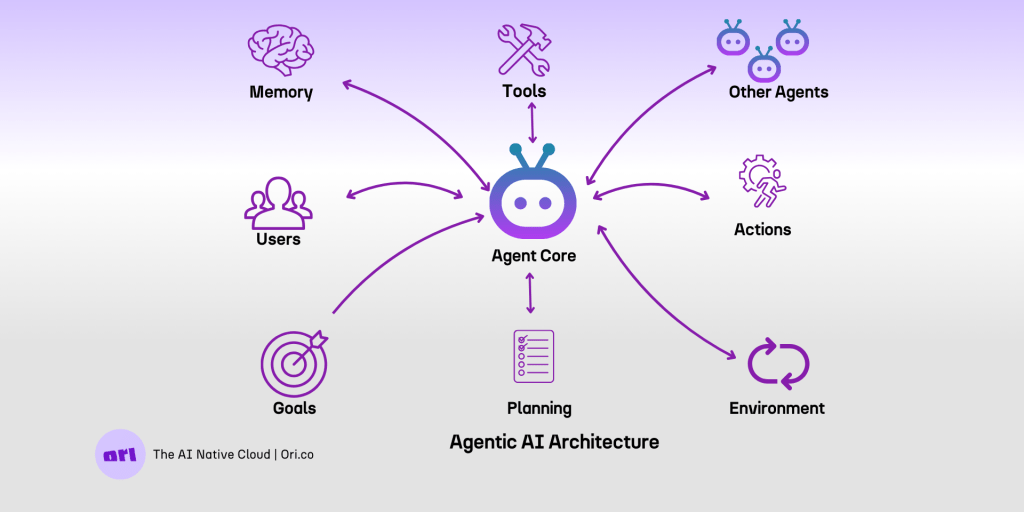
Agentic AI uses sophisticated reasoning and iterative planning to autonomously solve complex, multi-step problems.
Agentic AI systems ingest vast amounts of data from multiple sources to independently analyze challenges, develop strategies and execute tasks.
Agentic AI uses a four-step process for problem-solving:
1.Perceive: AI agents gather and process data from various sources, such as sensors, databases and interfaces.
2.Reason: An LLM acts as the orchestrator, that understands tasks and generates solutions. This step uses techniques like (RAG) to access organisation’s data sources and deliver relevant information.
3.Act: Use external tools and APIs, agentic AI can execute tasks based on the plans it created. Guardrails needs to be defined for AI agents to limit their scope.
4.Learn: Agentic AI adapt and become more effective over time
What is an Agent?
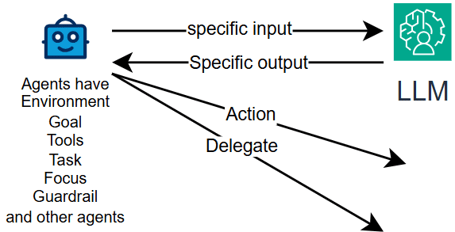
Agents are like humans interacting with LLMs but having specific goal, focus, limited tools, defined actions and confined environment.
What is the difference between a script and an agent?
| SCRIPT or RPA | AI Agent |
| Can have defined inputs, Outputs | Inputs and Outputs are in Natural Language |
| Script cannot research on a topic | Agents can research and read about a topic |
| Script cannot change its output based on the changes in the environment | Agent can give different output based on the changes in the environment and past experience |
MULTI AGENT SYSTEMS
Agentic AI in Multi-Agent Systems (MAS) means multiple specialized agents collaborating to solve complex problems. Single agents are more efficient when their scope of work is narrow, MAS leverages the strengths of various agents, each an expert in different tasks. This specialization allows for a more comprehensive approach to problem-solving.
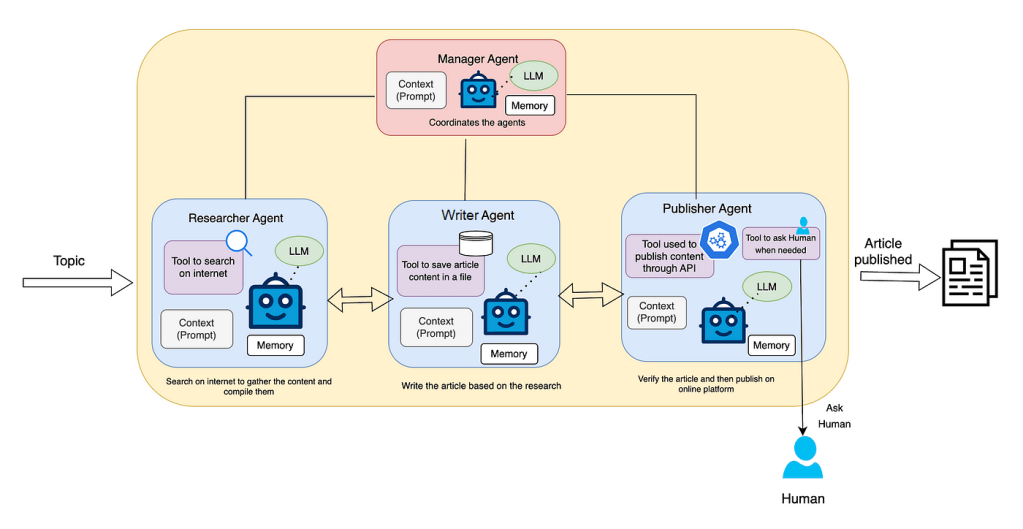
In a MAS, agents can autonomously understand the problem, plan, research and solve the problem, and provide feedback to the user. Agents in Multi Agent system also can talk to each other, save the results in common memory and delegate tasks to other agents. For instance, one agent might excel in data collection, another in data analysis, and yet another in decision-making. By working together, these agents can tackle problems that would be too complex for a single agent to manage effectively. Along with these agents, Human-in-the-Middle approach can put sufficient guardrails to prevent these agents to take any drastic step.
At the heart of these systems are Large Language Models (LLMs), which play a pivotal role in enhancing coordination and communication among agents. LLMs facilitate seamless information exchange, ensuring that each agent has access to the necessary data and insights to perform its tasks efficiently. This integration of LLMs into MAS not only improves the overall functionality but also enables the system to adapt to new information dynamically.
Example: A Multi Agent System is deployed for looking at customer issues and resolve them. 1st agent is looking at the new issue and understand the problem, (say items missing in the delivery). 2nd agent is finding reasons by looking at the fulfilment team’s notes and supply chain logs (say, not available with partner) , 3rd agent to take decision (re-ship or refund?), 4th agent for generating invoice, 5th agent for schedule delivery and their manager agent which oversee this whole process and involve a human if these agents are not taking right decision.
ERP Software Providers are going BIG on Agentic AI
SAP Joule
- Find insights from organisation’s data
- Chatbot type interface for employees
- Use a swarm of Agents like HR Agent, Marketing Agent, Sales Agent, Finance Agent etc
- Agents with enterprise reach
- Joule Studio for building custom agents
Salesforce AgentForce
- Autonomous support to employees and customers.
- Works with company data, documents, CRM data and Internet
- Creates and runs marketing campaigns
- Studio for building Custom agents for IT, retail, banking, operations, finance etc
Microsoft Dynamics 365
- Inject AI in every product
- Announced 10 AI Agents in Dynamics 365, sales order agent, supplier communication agent, account reconciliation agents etc.
- Copilot Studio for building custom agents.
USE CASES
| CCTV camera summarization agent – Ingests live or archived videos and extract insights for summarization and interactive Q&A, improving security and health & safety on site. |
| Employee help – An employee can conversate with HR Agent and say “Apply Holiday from 23rd Dec to 28th Dec” or “go to my profile and change my phone number to +44 74243xxxxxx”. Or “show me my payslip of Nov 2024” |
| Preventive Maintenance – optimization of planned preventive maintenance (PPM) of building’s assets like elevators, doors, alarms and charging stations. |
| Space Utilisation – Optimization of seating capacity in a venue or office. |
| Optimise Energy usage – A multi agent Building energy Agent can constantly monitor energy usage and optimize it on the fly. |
| Compliance and Regulation – LLM powered AI Agents can be very efficient in regulatory compliance by reducing human error in understanding legal document, building codes, fire codes, occupational safety and health regulations, energy efficiency standards, waste management policies, accessibility requirements etc. |
| New content creation and Homework checker – for School MS teams, Multi agent System can be created to produce new excercises for students and check their assignments |
LIMITATIONS OF AGENTIC AI
| Limitations | Explanation | Mitigation – Robust Agentic Framework |
| Hallucination | Hallucination is when an Agent produces incoherent and meaningless content | Use guardrails to keep the Scope of Agents narrow in order to avoid straying off topic |
| Lack of transparency | Users are not sure how agent arrived at a certain result | Robust agentic framework must have explanation of agentic AI behaviour |
| Biases | AI systems learn from data. If data has biases, AI system will show biases in the result. | Strict data quality check, aligned with organisation’s ethics policy is required. |
| Lack of ethics and common sense | Without guardrails, AI agents may want to finish the task using every method possible. | Guardrails for Agentic AI to bring human in loop before making unusual decisions. |
| Dependency on Data quality | If the organisation’s data is not of good quality, it will result in errors in judgment of an AI Agent | Good data quality is a paramount need for an organisation to leverage Agentic AI. |
| Unpredictability | AI agents work on LLMs which are trained in natural language. This can result in different output in each run. | Good prompt engineering for Agents to keep producing structured output. |
| Lack of Robustness | In case of unexpected result, it is difficult to debug as Agents are not scripts and do not always follow the same flow. | Again, choose reliable agentic framework which support error correction, training of agents and debugging. |
CONCLUSION
Agentic AI is a transformative leap in ERP softwares by enabling intelligent, autonomous decision-making and problem-solving.
Unlike traditional scripts and RPA, AI agents perceive their environment, reason with LLMs, take actions, use tools, and learn over time.
Multi-agent systems further enhance capabilities through collaboration on complex tasks.
Leading ERP providers like SAP, Salesforce and Microsoft are very bullish on Agentic AI, showcasing practical use cases.
However, it is crucial to address limitations and mitigate risks to fully harness the potential of agentic AI, ensuring robust, secure, and ethical implementations in enterprise environments.
 Abhishek's Little World
Liked this Article? Why not let me know